
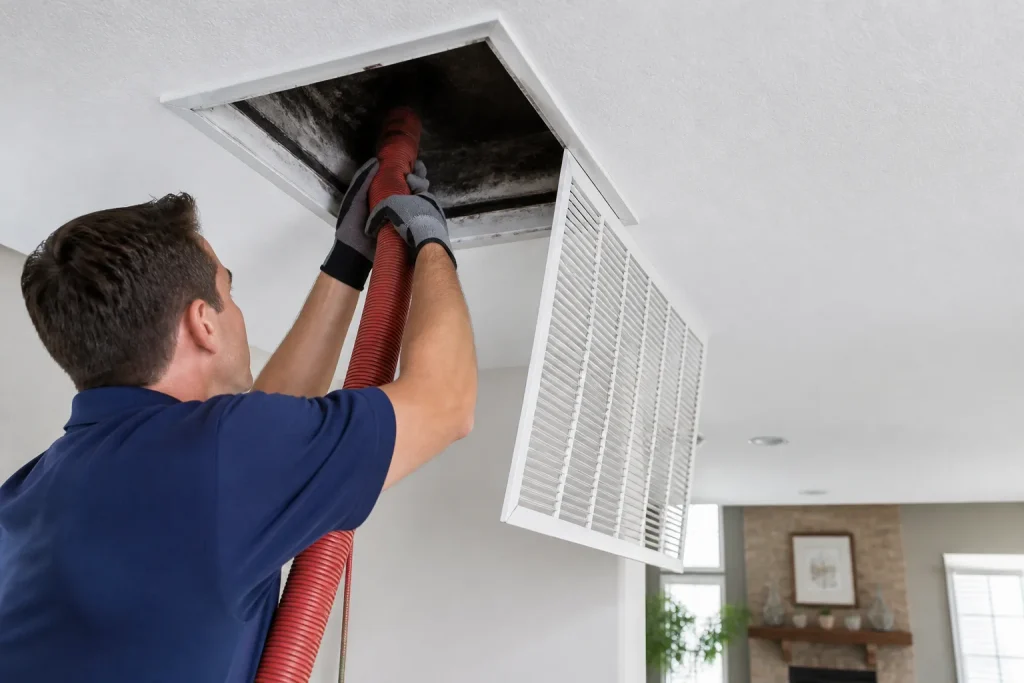
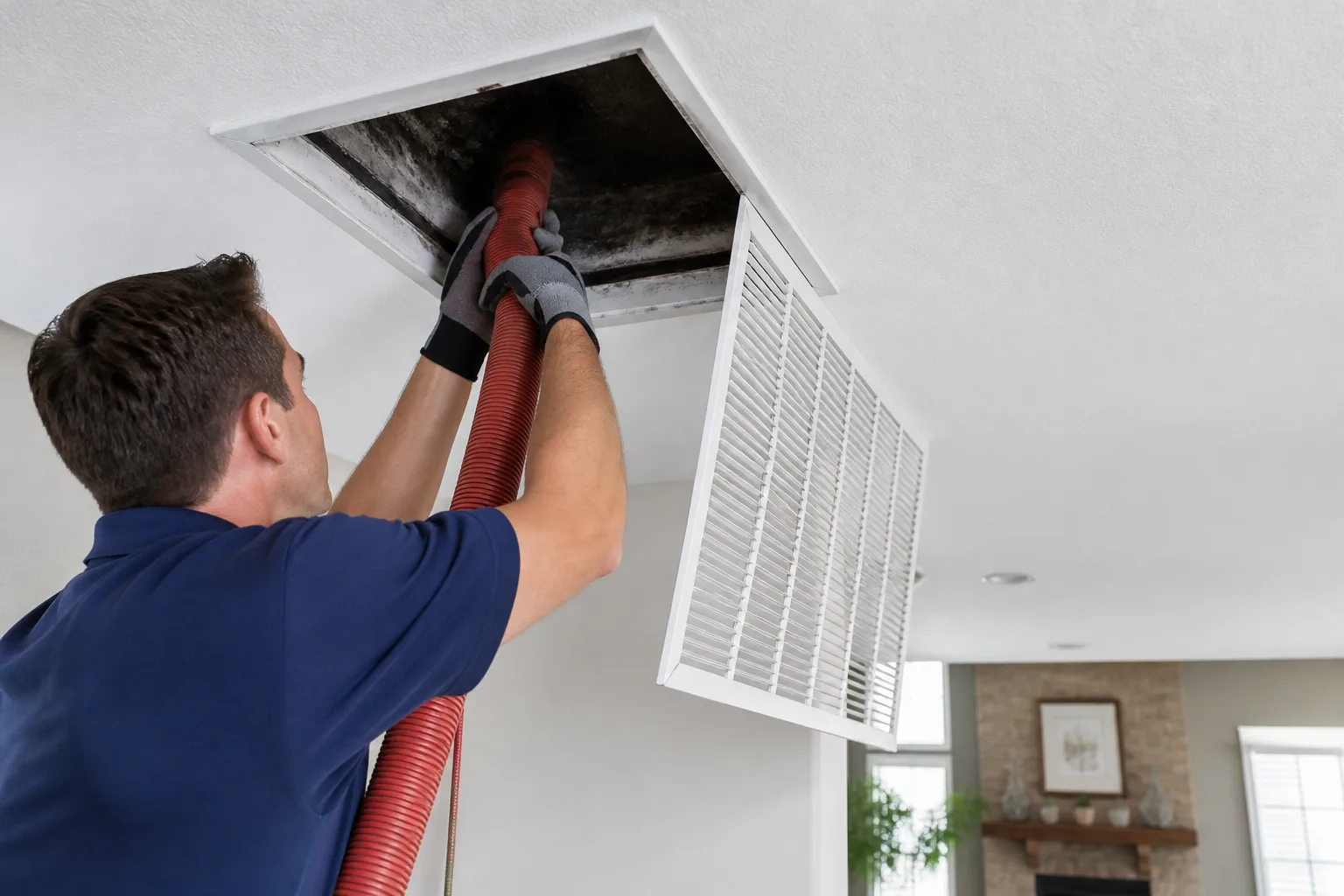
Emergency Air Duct Cleaning Near Me: What Broomfield Homeowners Should Do First
Running your HVAC after a sewage backup has reached your ductwork doesn’t help the system dry out. It aerosolizes fecal bacteria through every supply register in your home, room by room, until the whole house smells like the problem. The first move after a contamination event is almost always the same: shut the system down and keep it down until someone qualified has looked at what’s inside. Here’s the order we’d follow if it were our own house in Broomfield, and the reasons behind each step.
Key Takeaways
- Shut off the HVAC at the thermostat and the breaker before anything else. Don’t run the fan “to clear the air.”
- Photograph everything before a single contractor arrives. Your insurer will ask, and Broomfield claims move faster with a timeline.
- Not every emergency is a duct cleaner’s job. Sewage and active mold usually need a licensed remediation contractor first.
- A legitimate same-day crew brings containment equipment, not just a vacuum hose. Ask what’s on the truck.
- Don’t turn the system back on until the work has been verified.
What should you do in the first hour after a contamination event?
Stop the air handler. That’s the whole first move, and it’s the one people skip because the instinct is to air the place out. Turning the thermostat to OFF is step one, then kill power to the air handler at the breaker panel so a scheduled cycle can’t kick on while you’re not looking. If the contamination came from a flood or a sewage line backing up, this matters most: every minute the blower runs, it’s pushing contaminated air through the same ducts that serve your bedrooms and kitchen.
Next, isolate what you can. Close supply registers in the worst-affected rooms, block door gaps with towels, and keep people and pets out of the area. Open windows only if outdoor conditions allow and the contamination source is contained; cross-ventilation helps with smoke odor but does nothing for sewage bacteria sitting wet inside duct liner.
Then write down the timeline while it’s fresh: when you first noticed the problem, how long the HVAC ran before you shut it off, and what the source was. That last one seems trivial until an adjuster asks. It isn’t.
- Water intrusion: HVAC off, water shut off if a line is involved, wet materials documented.
- Smoke or fire: HVAC off, windows open where safe, soot deposits photographed before anyone wipes them.
- Pest discovery: HVAC off, droppings left undisturbed, entry point photographed.
- Visible mold at registers: HVAC off, no fans pointed at the growth, area sealed off.
If you’d rather not sort through this alone, call (866) 947-8482 and we’ll walk you through the shutdown while help is on the way.
How do you document a duct emergency for an insurance claim in Broomfield?
Photograph before you clean, move or repair anything. Insurers want evidence of the condition as it was, not as it looked after a well-meaning neighbor helped. Take wide shots that show the room in context, then close-ups of the register, the duct opening if it’s exposed, and any water line or pest evidence. Timestamped phone photos work fine. What matters is that the sequence is clear.
From what we’ve seen working in Broomfield, claims that go smoothly tend to have three things in common:
- A written timeline. Date and rough time of the event, when the HVAC was shut off, and when each photo was taken.
- Model and serial numbers. Your furnace and air handler, photographed on the data plate. Adjusters need to know what equipment was affected, especially if replacement is on the table.
- A record of HVAC run time. Even an estimate (“it ran about two hours before I caught it”) helps establish the spread.
Broomfield-area insurers handle storm and water claims often enough that they know the questions to ask. The homeowner who has answers ready tends to get a smoother process than the one reconstructing it from memory three weeks later. Keep receipts for anything you had to throw out or replace, too, and don’t discard damaged material until you’ve been told it’s okay to.
Which duct emergencies need a remediation contractor first?
Sewage contamination and active mold growth usually call for a licensed remediation contractor before any duct cleaning happens. That’s not us being cautious for the sake of it. Sewage carries pathogens that need proper disinfection protocols, and active mold means there’s a moisture source that has to be corrected or the growth comes right back. A duct cleaner who skips that step is cleaning a surface that will be re-contaminated within weeks.
Other situations a qualified duct cleaning company can often handle as part of the same service:
- Smoke and odor contamination after a contained fire, once the fire department and your insurer have cleared the property.
- Rodent or pest debris in ductwork, where the entry point can be identified and sealed.
- Dry water intrusion where materials were wet but have since dried and no mold is present.
- Heavy dust and debris after renovation work, which is messy but not hazardous.
The line between “clean it” and “remediate it first” isn’t always obvious from the outside. When we’re unsure, we say so and recommend the more careful path. Better a day’s delay than a system that needs tearing out later.
What should a legitimate emergency duct cleaning company bring?
Ask what equipment is on the truck before you book. A crew that shows up with a shop vacuum and a hose is not equipped to touch a contaminated system, whatever the ad said. Professional-grade cleaning systems like Rotobrush and Nikro are built for this work; they agitate and extract rather than just suck surface dust. But the equipment that separates a real emergency response from a marketing claim is containment.
Containment means the contaminants get captured, not just loosened into the air you breathe. We use Abatement Technologies containment equipment, borrowed from remediation work, for exactly this reason: negative pressure keeps what’s inside the ductwork from recirculating into the room while it’s being cleaned. Without it, an “emergency” cleaning can leave your indoor air worse than it started.
Beyond that, a crew set up for this work should be able to repair and seal what they find. Loose joints and disconnected runs are common after water damage or pest activity, and cleaning a duct system that leaks just means the contamination has somewhere new to go. Duct repair and sealing belongs in the same visit, not a separate appointment weeks out. And when the system needs an air-quality upgrade afterward, working with Aprilaire and Honeywell product lines means the fix can happen without bringing in another contractor.
Our technicians have up to 8 years of experience, and we’d rather answer a pointed equipment question than have you find out after the fact that the wrong tool was used on a contaminated system.
When can you turn the HVAC back on?
Not until the work has been verified. That’s the step most homeowners skip because the house feels normal again, but “smells fine” is not the same as “safe to run.” Verification means someone confirms the duct system is clean, dry, and sealed, and that the air handler itself hasn’t been compromised. Depending on what happened, that might involve an HVAC inspection of the blower and coil, or an air quality test to confirm contaminant levels are back to normal.
Here’s the sequence we recommend after any contamination event:
- Cleaning and containment completed by a qualified crew.
- Duct repair and sealing done on any joints, runs, or connections found damaged.
- Inspection of the HVAC unit itself – blower wheel, coil, and cabinet, since contaminants travel both ways.
- Air quality verification before the system goes back into regular service.
- Filter replacement, and a note of the date so you know when the next one is due.
Then, and only then, flip the breaker back on. If the system was never verified, running it just redistributes whatever’s left. Taking an extra day to confirm is far cheaper than cleaning the whole house twice.
When to call a pro
Call us when the problem is beyond what a filter change and a good vacuum can fix: anything wet inside the ductwork, any pest activity, any smoke odor that lingers, or any contamination you can see at a register. Call immediately if sewage or floodwater reached the system. Our air duct cleaning service covers the full system, and we handle dryer vent cleaning and HVAC cleaning in the same visit so you’re not scheduling three contractors for one problem. If a repair turns up mid-clean, we fix what we find rather than handing you a list and leaving.
We answer 24/7. Fast dispatch from 7am to 7pm, Sunday through Friday. The estimate is free, and the price is set per job by a written estimate before any work starts, so there’s no surprise invoice after the truck pulls away.
Related services in Broomfield
If you’re still working out what’s wrong with your system, the overview on our Broomfield Air Duct Cleaning page walks through what a full-system assessment covers, including how we check ductwork, the HVAC unit, and air-quality equipment together.
What happens when you call
- 1
A real person answersNo phone trees – you reach a local pro.
- 2
You get an upfront price rangeHonest numbers before anyone is dispatched.
- 3
A background-checked tech heads outLicensed & insured, dispatched right away.
- 4
You approve before work beginsNothing starts until you say go.
The Bottom Line
Shut the HVAC off first, photograph everything second, and don’t let anyone clean a contaminated system without containment equipment and a clear plan. Sewage and active mold usually need remediation before cleaning; smoke, pests, and dried water intrusion can often be handled in one visit by a crew set up for it. Verify before you turn the system back on. If you’re in Broomfield and need help, Broomfield Air Duct Cleaning offers free estimates. Call (866) 947-8482. We answer 24/7. Fast dispatch from 7am to 7pm, Sunday through Friday.
Frequently Asked Questions
We price per job, not per vent, and the written estimate sets the final price before any work starts. Contaminated systems involve more containment and inspection than routine cleaning, so the estimate reflects the actual scope. The estimate itself is free. Call (866) 947-8482 for an exact quote.
No. Running the fan aerosolizes contaminants through every supply register in the house, which spreads the problem instead of solving it. Shut the system off at the thermostat and the breaker, and leave it off until it’s been cleaned and verified.
Sewage contamination and active mold growth usually require a licensed remediation contractor first. Smoke, pest debris, and dried water intrusion can often be handled by a qualified duct cleaning company as a combined service. If it’s unclear, we’ll tell you which path we’d take and why.
Ask for before-and-after photos of your own ducts, not stock images, and ask what verification was done before the system was handed back. A crew working with containment equipment can show you the condition before and after. If nobody can show you, that’s your answer.
Written by the team at Broomfield Air Duct Cleaning.
Need Air Duct Cleaning Help?
Call Broomfield Air Duct Cleaning - the local pro we connect you with is licensed and insured, with free written estimates in Broomfield.
(866) 947-8482